Valkey vs Redis: Which One I'd Run in Late 2026
By Aakash Verma · · 4 min read
Short version: for a new project on your own server or on AWS, I'd run Valkey. For an app already on Redis 8 that uses the search, JSON or vector features that now ship inside Redis, I'd leave it alone. Everything else is detail, but the detail is where people lose a weekend, so here it is.
Checked on October 28, 2026 against the Valkey releases on GitHub, the Redis releases, both projects' docs and the ElastiCache pricing page.
How we got two of them
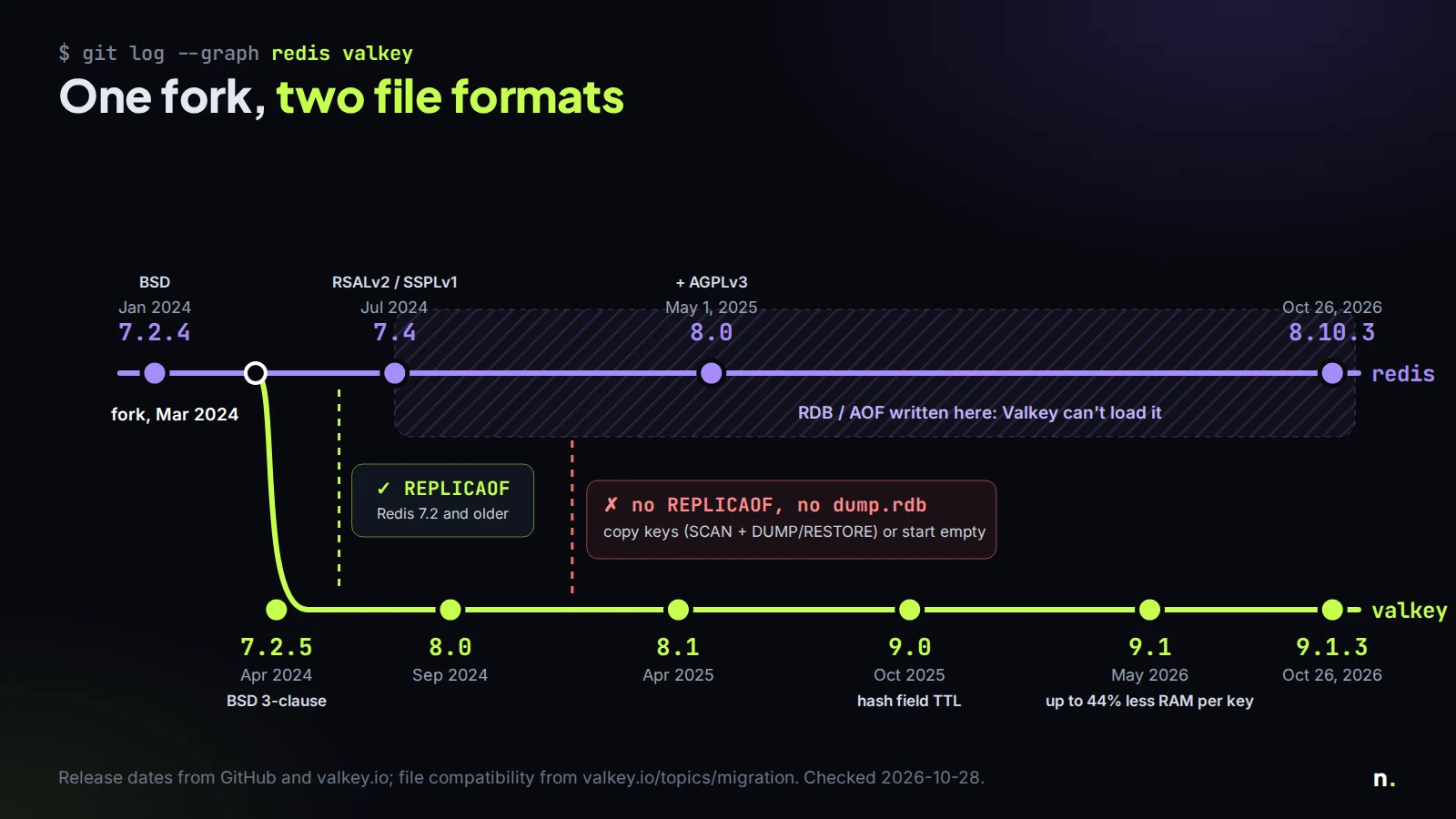
In March 2024 Redis moved everything from 7.4 onward off the BSD license to RSALv2 and SSPLv1, which are source-available, not open source. Within about a week the Linux Foundation announced Valkey, a fork of Redis 7.2.4 under the old BSD 3-clause license, with maintainers from AWS, Google, Oracle and others. Then on May 1, 2025, Redis 8 added AGPLv3 as a third license option, so Redis is open source again, just under a copyleft license instead of a permissive one.
Does the license matter for you? If you run Redis as the cache behind your own app, AGPL almost certainly doesn't change anything. It matters if you sell Redis itself as a service, or if your company's legal team has a blanket "no AGPL" rule. Those rules exist, and I'd rather not have that conversation at all. BSD avoids it.
Where each one is today
Both are moving fast, which surprised me. Two years after the fork, neither side is coasting.
Valkey is on 9.1.3 (released October 26, 2026), with 9.2.0-rc1 out since September 16. 9.0 (October 2025) brought the things people had been asking for: hash field expiration, numbered databases in cluster mode, and atomic slot migration for resharding. 9.1 (May 2026) was mostly efficiency: per the Valkey team's memory write-up, per-key overhead dropped by up to 44% for strings with no config change. That's free RAM on every cache box, and RAM is what you pay for.
Redis is on 8.10.3, released the same day. The big change in Redis 8 is that the old Redis Stack pieces (JSON, the Query Engine for search, time series, probabilistic types) are part of Redis Open Source now. You install one thing and get them all. Valkey has its own versions of most of this (JSON, Bloom filters, vector search and, since March, full-text search) as separate modules, most of them packaged together in the valkey-bundle image, but Redis's are older and more complete.
A funny detail: on October 26 both projects shipped security releases for a heap buffer overflow in cluster Pub/Sub message handling, across every supported branch. Two codebases, still sharing a lot of bugs.
The data-file break nobody reads about
This is the part I'd tell anyone before they plan a migration.
Valkey reads and writes RDB and AOF files compatible with Redis OSS 7.2. Redis 7.4 and later write files Valkey can't load. That's in Valkey's own migration guide, not a forum rumour. So:
If you're on Redis 7.2 or older, moving is easy. Point a Valkey instance at the old server as a replica, let it sync, promote it, switch the connection string. Or copy the dump.rdb across.
If you're on 7.4 or 8.x, you can't do either. You copy keys at the command level (SCAN, DUMP/RESTORE or type-aware reads and writes, keeping TTLs), or you skip copying altogether.
Skipping it is usually right, honestly. Most apps use Redis for a cache, sessions and a job queue. The cache refills itself. Sessions you can either migrate or accept that people log in once more. The queue is the only part I'd be careful with: stop the producers, let the workers drain it to zero, then cut over. If you run BullMQ, that's the moment its delayed and repeatable jobs bite you, because they live in Redis too and won't drain on their own. Write down what's scheduled before you switch.
Client libraries don't care. Valkey speaks the same protocol (RESP2 and RESP3), so ioredis, node-redis, phpredis and Predis connect without a code change. Laravel's Redis config works as is.
What AWS charges for each
If you're on ElastiCache, the choice makes itself. Per the pricing page today, Valkey is 20% cheaper on node-based clusters and 33% cheaper on Serverless than the other engines.
In US East, a cache.r7g.large node is $0.1752 an hour on Valkey (about $128 a month) against $0.219 on Redis OSS (about $160). Serverless is where it gets silly: Valkey's minimum billed storage is 100 MB, Redis OSS's is 1 GB. At $0.084 per GB-hour, an idle Valkey Serverless cache costs about $6 a month. The Redis OSS minimum, at $0.125 per GB-hour, is about $91 a month for a cache that might hold 20 MB. For a side project or a staging environment, that's the whole argument.
Moving an ElastiCache Redis OSS cluster to Valkey is an in-place engine upgrade that AWS supports without a new cluster, which is about as easy as a database change gets.
Where I'd still pick Redis
If you're using the Query Engine for search or secondary indexes, RedisJSON paths everywhere, or vector sets, Redis 8 is the more mature home. Same if you're on Redis Cloud and happy with it, or you need its active-active replication across regions. I wouldn't migrate a working app away from features it depends on just to change a license that doesn't affect it.
For a fresh project, a self-hosted cache, Laravel Horizon or a Node job queue, I'd install Valkey and stop thinking about it. It's the same commands, the same clients and the same INFO memory output, with less RAM per key.
If you're weighing a switch on a production app and want someone to look at what's actually stored in yours first, book a free call.
Introductory offer
Free cloud cost optimization. You only pay from what I save.
I cut your AWS, cloud, Supabase or Vercel bill for free and keep half of what I save for 6 months. Save nothing, pay nothing. Code, architecture and infrastructure.