Vue vs React in 2026: Which One I'd Pick for Your App
By Aakash Verma · · 4 min read
Vue or React? For a new product with a small team, I'd pick Vue if the people building it like templates and want fewer decisions, and React if you plan to hire a lot, lean on AI coding tools, or need React Native later. Both are fine. Neither one is going to be the reason your app fails.
I write mostly Vue and some React, so take my bias into account. This site is Nuxt. The versions below are what npm showed on November 20, 2026: Vue 3.5.45, React 19.3.1, Nuxt 4.6.4, Next.js 16.4.6.
The numbers people quote
React is much bigger. npm counted about 274 million React downloads in the week of November 12 to 18, 2026, against about 26 million for Vue. Next.js had about 99 million that week, Nuxt about 3.6 million.
That ratio matters in exactly two places: hiring and AI tools. It doesn't matter for performance, and it doesn't tell you which one is nicer to work in. Download counts include every CI run and every dependency that pulls React in, so read them as "how much of the world runs on this", not "how many developers chose it".
Where they actually differ
The real difference is how each one decides what to re-render.
Vue tracks what you read. You put state in a ref() or reactive(), the template reads it, and Vue knows which bits of the page depend on which values. Change the value and only those bits update. You almost never think about it.
React re-runs your component function when state changes and works out the difference afterwards. That's why React code grows useMemo, useCallback and dependency arrays, and why a missing dependency is one of the most common React bugs there is. The React Compiler (the babel-plugin-react-compiler package is at 1.0.0) memoizes a lot of that for you now, which closes much of the gap. It doesn't remove the mental model, though. You still need to know why a component rendered.
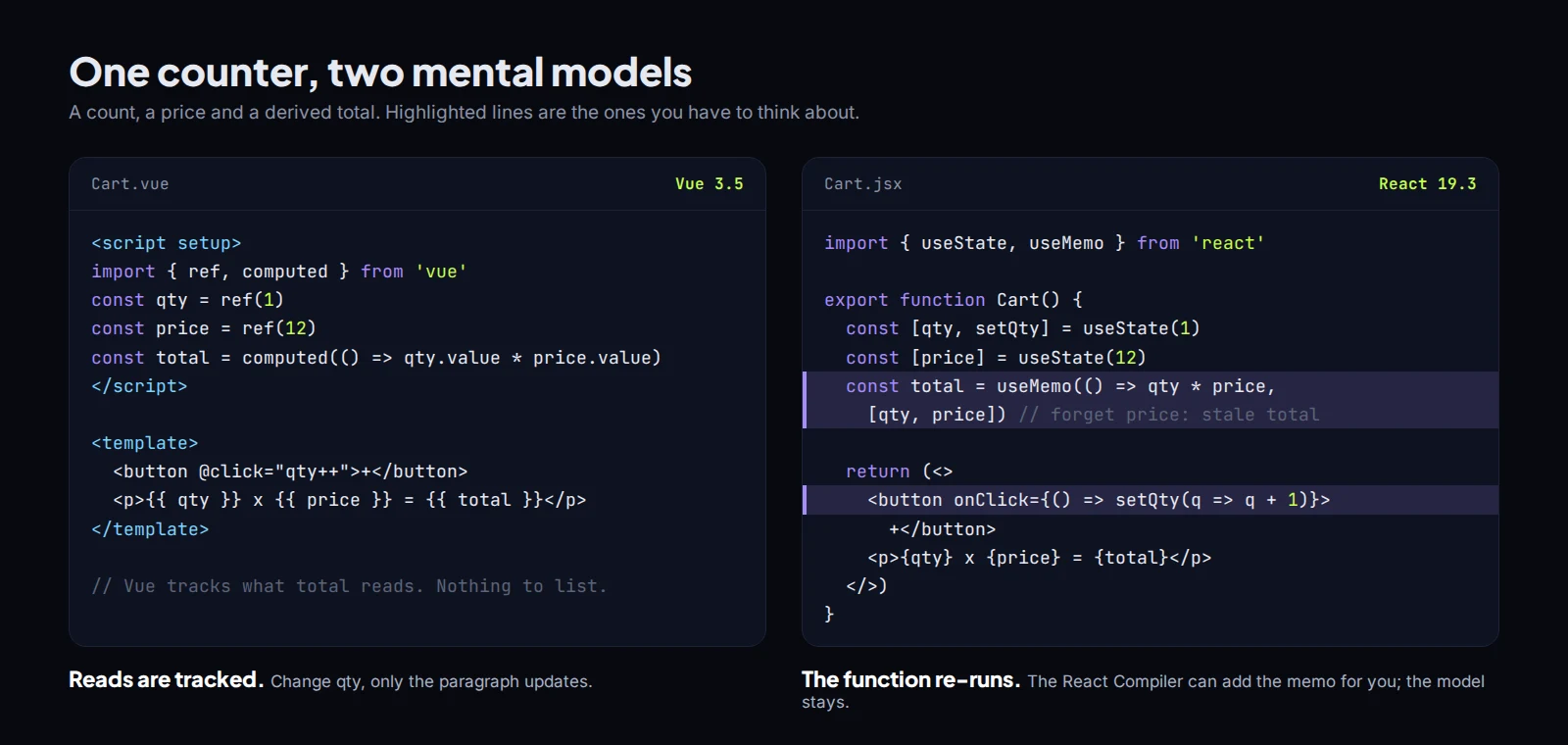
The other big difference is templates vs JSX. Vue's single-file components keep HTML, script and styles in one file, and the HTML looks like HTML. A designer can open a .vue file and change a class without breaking anything. JSX is JavaScript all the way down, which is more flexible and also easier to turn into a mess, because nothing stops you putting a 40-line ternary inside a return statement.
Hiring and handover
This is where React wins, and it isn't close. If you're a founder who plans to hand the code to a different freelancer next year, or to grow a team of five, there are simply more React developers. Agencies default to it. Most AI app builders default to it too: the code they generate is React almost every time.
Vue developers are easier to find than people think, especially in Europe and Asia, and a good Vue developer picks up a Vue codebase faster than a React developer picks up someone else's React codebase, because Vue projects look alike. There's one blessed router, one blessed store (Pinia), one meta-framework (Nuxt). React projects all make their own choices: Next or Vite, Redux or Zustand or TanStack Query, CSS modules or Tailwind or styled-components. Two React codebases can feel like two different frameworks.
AI coding tools
If you're going to write a big part of the app with an AI assistant, React has an edge, because there's simply more React in the training data and the tools reach for it first. In practice the gap is smaller than it sounds. The assistants write decent Vue 3 with <script setup> now. The thing to watch is older patterns sneaking in: Options API code mixed into a Composition API project, or Vue 2 syntax that doesn't run. A short rules file that says "Vue 3, Composition API, <script setup>, Pinia" fixes most of it.
Nuxt vs Next
Most real apps won't use bare Vue or bare React; they'll use the meta-framework. Next.js has more features and more surface area: the App Router, server components, server actions, and a strong pull towards Vercel for hosting. Nuxt is smaller and, to me, calmer. File-based routing, server routes in server/api, and it deploys happily to Cloudflare, a Node server or anywhere else. This site is Nuxt on Cloudflare.
If your app is mostly forms, dashboards and CRUD screens, either one is overkill in places and fine overall. If it's a content-heavy site that needs to rank in Google, both do server rendering well; that decision is about the team, not the framework.
When each one is the wrong pick
React is the wrong pick when the team is two people who love templates and will spend weeks arguing about state libraries instead of shipping. Vue is the wrong pick when you know you'll need a React Native mobile app sharing code with the web app, or when your hiring plan is "post a job and get 200 applicants by Friday".
And if you're choosing for a Laravel backend, Vue has the longer history there (Laravel shipped with it for years, and Inertia supports both), so I'd lean Vue unless the team already knows React.
If you're stuck between the two for a real project, or you've got a half-built app in one of them that needs someone to finish it, I build in both. Book a call; the first conversation is free.
Introductory offer
Free cloud cost optimization. You only pay from what I save.
I cut your AWS, cloud, Supabase or Vercel bill for free and keep half of what I save for 6 months. Save nothing, pay nothing. Code, architecture and infrastructure.