TypeScript vs JavaScript in 2026: When I'd Still Skip the Types
By Aakash Verma · · 4 min read
TypeScript or JavaScript? For anything that will have more than one developer, live longer than a few months, or get written partly by an AI assistant, I'd use TypeScript. For a 200-line script, a quick prototype you'll throw away, or a codebase where nobody wants to learn it, plain JavaScript is fine and I won't pretend otherwise.
That's the short answer. The longer one is mostly about what changed in the last two years, because a lot of the old arguments against TypeScript don't hold anymore.
What TypeScript actually is
TypeScript is JavaScript with type annotations. You write function total(items: Item[]): number, a checker reads the whole project and tells you when something doesn't fit, and then the types are stripped out. What runs in the browser or in Node is plain JavaScript. There's no TypeScript runtime and no speed difference at runtime, in either direction.
So the comparison isn't "which language is faster" or "which one can do more". It's "do you want a checker reading your code before it ships, and what does it cost you to have one".
What it catches
The boring stuff, and that's the point. A misspelled property. A function that can return undefined being used as if it can't. An API response that changed shape. A refactor that renamed a field in 30 files and missed two.
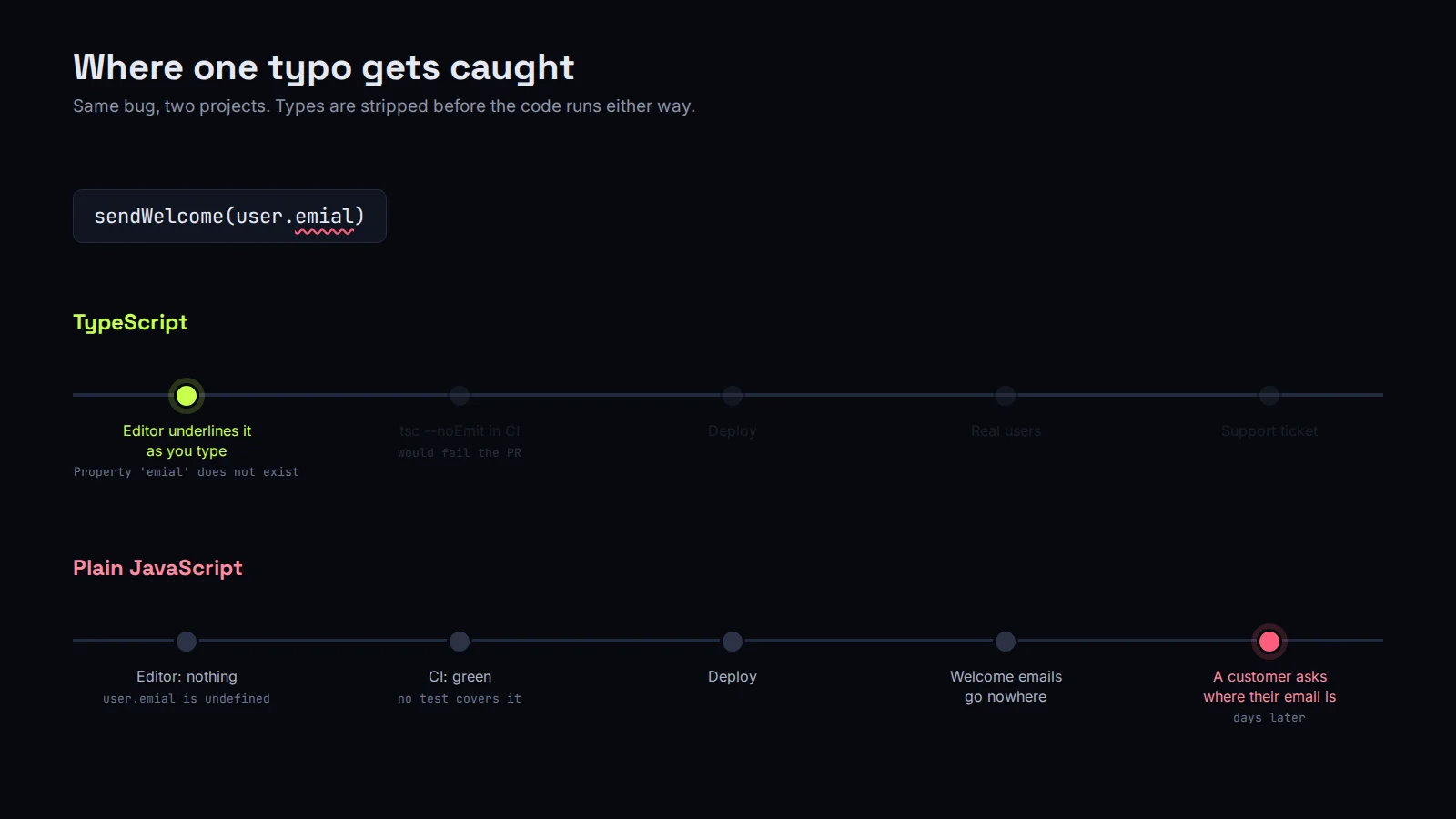
In plain JavaScript, user.emial is just undefined. Nothing complains. You find out when a welcome email goes to nobody, maybe days later, maybe from a customer. In TypeScript the editor underlines it the second you type it. That one class of bug, multiplied over a codebase, is most of the value.
The second big win is reading code you didn't write. When I open a project and see createInvoice(customer: Customer, lines: InvoiceLine[], opts?: { draft?: boolean }), I know what to pass without opening three other files. That matters a lot when the codebase was written by someone else and they're no longer around to ask.
What it costs
A build step, used to be the main complaint. That's mostly gone. Vite, Nuxt, Next, Bun and Deno all take .ts files without any setup. And Node itself now runs TypeScript files directly by stripping the types: node server.ts works on current versions, including Node 26, which became the LTS line on October 28, 2026. It doesn't type-check when it does that, it just removes the annotations, so you still run tsc --noEmit in CI. But you no longer need ts-node or a compile step to start a server.
Speed was the other complaint, on big projects. TypeScript 7 is the compiler Microsoft rewrote in Go, and npm shows typescript at 7.0.2 now. On a large codebase the type check that used to make you wait now mostly doesn't.
What's left is the real cost: time spent on types themselves. Generic utility types, fighting a library with bad type definitions, as unknown as Whatever to get past something you know is fine. On a small team with a deadline that can eat hours. My rule is to type the edges (API responses, function signatures, database rows) properly and be relaxed inside a function. strict: true stays on, any is allowed with a comment saying why.
AI tools changed the math
This is the argument I find most convincing in 2026. When an AI assistant writes a chunk of your code, the type checker is the cheapest reviewer you have. The assistant invents a field that doesn't exist, or calls your function with arguments in the wrong order, and tsc catches it before a human has to. Most assistants also write better code when they can see types, because the types tell them what your data looks like without guessing.
In plain JavaScript the same mistakes slip through until something runs. If you're building with Cursor, Copilot or anything like it, I'd treat TypeScript as close to required.
Popularity, if you care
npm counted about 451 million downloads of the typescript package in the week of November 13 to 19, 2026. For comparison, React had about 275 million that week. Download numbers include every CI run, so they mostly say "TypeScript is in almost every serious JavaScript project's toolchain", which matches what I see in client code.
For hiring, it means most JavaScript developers already know TypeScript. You're not narrowing the pool much by requiring it.
When I'd still pick plain JavaScript
- A small script: a one-off data migration, a cron job that hits one API, a build helper.
- A prototype you'll genuinely throw away. Be honest about that, because most "throwaway" prototypes end up in production.
- An existing JavaScript codebase that works and isn't changing much. Rewriting it to TypeScript for its own sake is rarely worth it. Add
// @ts-checkand JSDoc types to the files you touch and get most of the editor help for free. - A team that doesn't want it. Forcing TypeScript on people who will fill it with
anygives you the cost and none of the benefit.
Moving an existing project over
Don't do it in one go. Rename one file at a time, starting with the ones that hold your data shapes (API clients, database models), turn on allowJs so both live side by side, and tighten strict once most files are converted. The order matters more than the speed: types on the data first, UI last.
If you've got a JavaScript or half-typed codebase and want someone to get it into shape, or an app that needs a developer who can read what's already there, book a free call. All consultation is free.
Introductory offer
Free cloud cost optimization. You only pay from what I save.
I cut your AWS, cloud, Supabase or Vercel bill for free and keep half of what I save for 6 months. Save nothing, pay nothing. Code, architecture and infrastructure.