Vibe Coding Tools: Sort Them by Who Can Read the Code
By Aakash Verma · · 4 min read
Most lists of vibe coding tools rank them by how good the demo looks. I sort them by a duller question, because it's the one that decides what happens after the demo: when the app breaks at 2am, can a developer open the code, run it on a laptop, and fix it without the tool that wrote it?
That splits the field into two groups. App builders, where you describe the app in a chat and the tool owns the editor, the hosting and usually the database. And coding agents, which work inside a normal repository on your machine or in your GitHub, and leave behind a codebase that any developer can pick up. Both are real tools. They suit different people, and mixing them up is how founders end up paying twice.
Prices below were checked on the vendors' own pages between November 17 and 22, 2026.
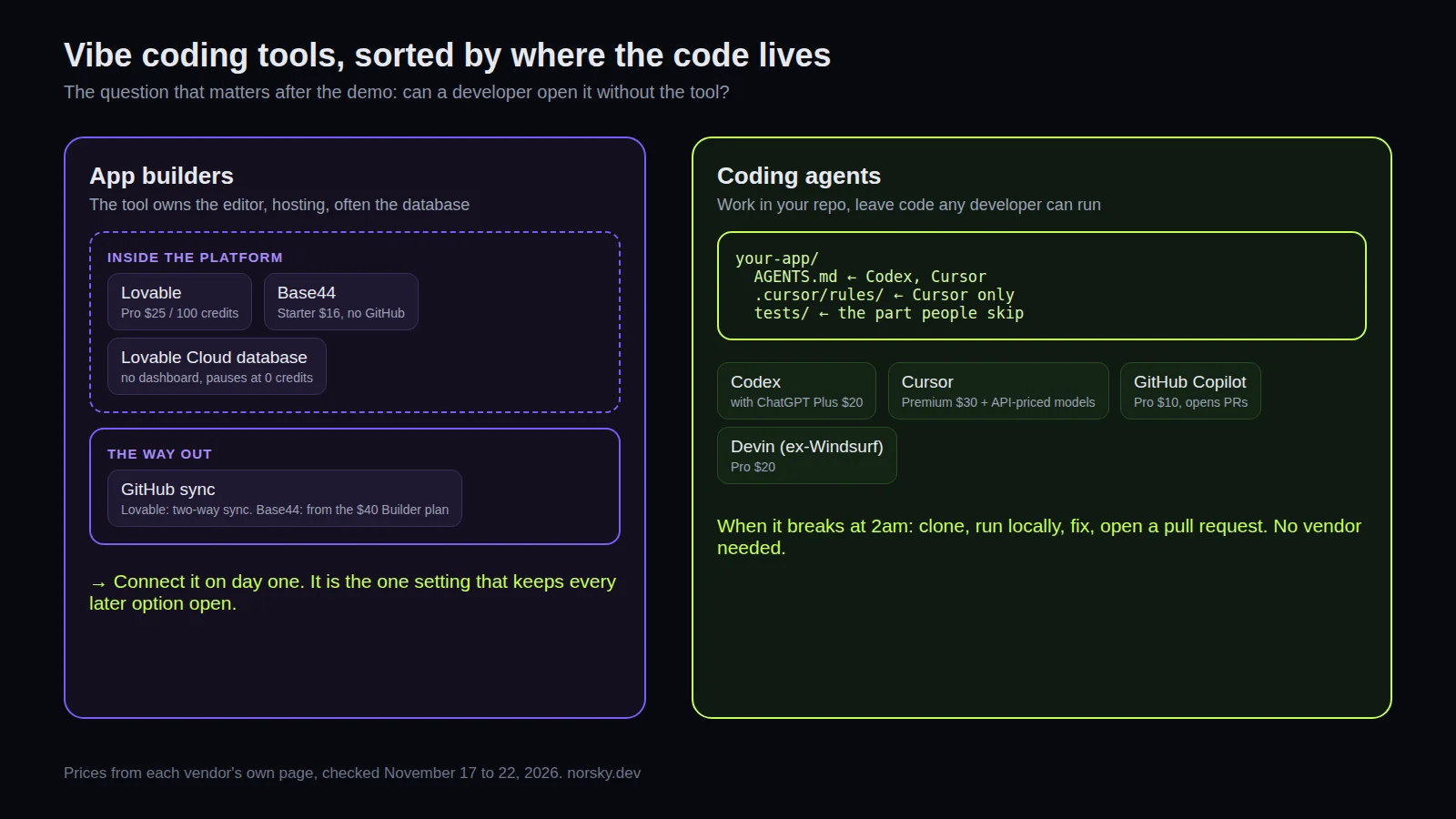
App builders: fastest start, the code lives with them
Lovable. The best known of the builders. Pro is $25 a month for 100 credits ($21 billed yearly), going up to $200 for 800 per Lovable's plans docs. It syncs to GitHub both ways, which is the single most important feature on this whole list, because it means the code exists outside Lovable. The catch is the backend. Apps on Lovable Cloud run on a database you don't get a dashboard for, and when the credit balance hits zero, Cloud apps pause.
Base44. Cheaper entry ($16 a month billed yearly on Base44's pricing page), but GitHub sync only starts on the $40 Builder plan. On the cheaper plans the code doesn't leave the platform. If owning the code matters to you, and it should, compare the $40 plan, not the $16 one.
What I like about builders: a non-developer gets a working product in a weekend, and for a lot of ideas that's the right amount of investment. What I'd watch: anything touching payments, permissions or personal data, because the builder writes it as confidently as everything else and there's nobody in the loop who reads it.
Coding agents: slower start, the code is plainly yours
Cursor. An editor built around AI. The $8 Plus plan only gets Grok models; for OpenAI and other third-party models you need Premium at $30, and those third-party models bill at API list price on top, per Cursor's pricing docs. That last part surprises people more than anything else on this list.
Codex. OpenAI's coding agent, in the terminal, the editor and the cloud, included in ChatGPT Plus at $20 on OpenAI's pricing page. It reads an AGENTS.md file of project rules in the repo, so you can write "never touch the migrations folder" once instead of repeating it in every prompt. Cursor reads the same file, which makes switching between them cheap.
GitHub Copilot. The cheapest serious option, Pro at $10 a month on GitHub's plans page, and it lives where your code already is. Its coding agent opens pull requests, which is exactly the workflow I'd want a team on.
Devin (formerly Windsurf). windsurf.com/pricing now redirects to Devin's page, Pro at $20. Worth knowing before you follow an old tutorial.
None of these need you to understand the code. But all of them assume someone eventually will, which is the honest difference from the builders.
How I'd pick
If you can't read code and want to find out whether anyone wants the product: a builder, on the plan that includes GitHub sync, connected to GitHub on day one. That one setting keeps every later option open.
If you can read code, or you're paying someone who does: a coding agent, in a real repo, with tests that run on every change. The agent is faster at writing code than any person. It isn't better at noticing that the code it wrote last Tuesday quietly broke the invoice export.
If you started on a builder and the app now has paying users: this is the point to move the backend somewhere you control and get a developer to read what's there. Usually that's an afternoon of reading and a few days of fixing, not a rewrite. The app is mostly fine. It's the parts nobody looked at that cause trouble, and those are almost always the same three: database access rules, payment webhooks, and secrets sitting in frontend code.
The tool matters less than the second pair of eyes
AI tools write a lot of good code now, and I'd still never ship what one writes without reading it. That's not a knock on the tools. It's the same rule I'd apply to a talented junior developer: fast, often right, and occasionally confidently wrong in a way that only shows up in production.
If you're building with Lovable and want that second pair of eyes before launch, my agency Lovable 2 Live takes Lovable apps to production. For anything else, whatever tool wrote it, book a free call. All consultation is free.
Introductory offer
Free cloud cost optimization. You only pay from what I save.
I cut your AWS, cloud, Supabase or Vercel bill for free and keep half of what I save for 6 months. Save nothing, pay nothing. Code, architecture and infrastructure.