Bun vs Node in Late 2026: What I'd Run in Production
By Aakash Verma · · 4 min read
Short answer: for a server that has to stay up, I'd still run Node, specifically Node 24 today and Node 26 once it turns LTS on October 28. For everything around that server (installing packages, running scripts, tests, one-off tools), I'd happily use Bun. That split is boring, and it's where I keep landing every time I look at this again.
Everything below was checked on October 26, 2026: Node's release schedule on GitHub, the nodejs.org release index, npm for Bun's versions, and Bun's own Node.js compatibility page.
Where the two stand this week
Bun's latest stable is 1.4.4, released October 22, and it ships canary builds almost daily on top of that. Five 1.4 releases since August 20 is fast, which is great for features and a little less great when you want to pin something and forget about it for a year.
Node is in the middle of a handover. Node's release schedule has Node 24 ("Krypton") moving to maintenance on October 20 and staying supported until April 30, 2028. Node 26 becomes the active LTS on October 28, 2026, with support until April 2029. Node 22 runs until April 2027, and Node 20 is already past end of life (April 30, 2026). If you still have a Node 20 service somewhere, that's a more urgent problem than which runtime is faster.
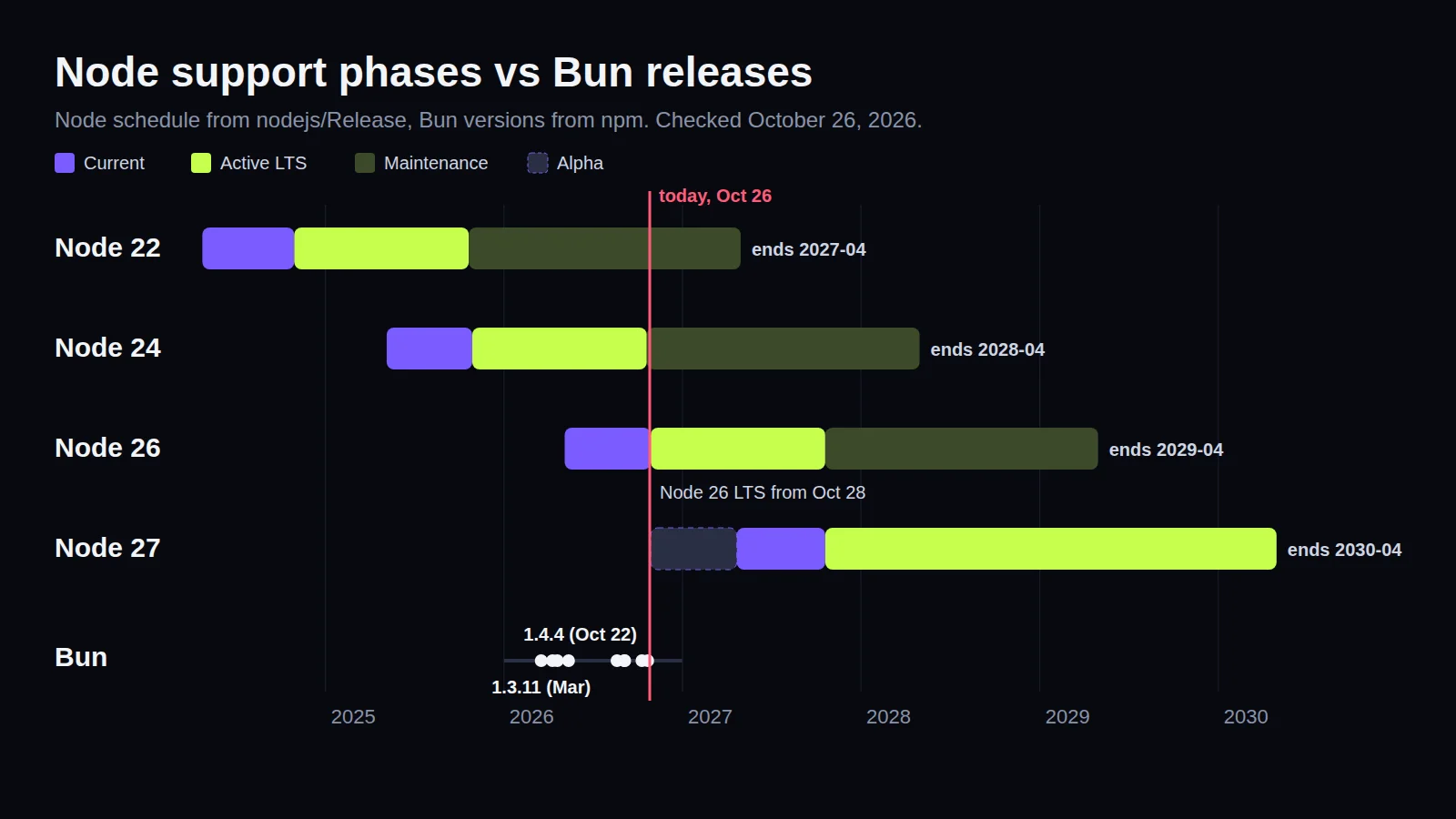
One more thing on that schedule that caught my eye: Node 27 gets an alpha on October 28 and a proper release in April 2027. So the "even numbers become LTS" habit is still the thing to plan around.
Compatibility, from Bun's own page
I like that Bun publishes this honestly. Most core modules are marked fully implemented, and some come with numbers: node:http2 passes 94% of Node's test suite, node:fs 98%, node:events 95%. For a typical Express or Hono API talking to Postgres, that's enough. It just works, and installs are noticeably quicker.
The yellow entries are where I'd be careful, because they're exactly the things you only notice in production:
node:async_hooks:AsyncLocalStorageworks, butcreateHookand friends are stubs. Bun doesn't invoke the hooks. Anything that traces requests through those hooks gets less than it expects.node:crypto: Bun uses BoringSSL, so there's nosecp256k1, nochacha20-poly1305, noed448, nodsa. Fine for most apps. A hard stop for a few.node:https: on the server side, request sockets don't havegetPeerCertificate(), andSNICallbackisn't supported. If you do mutual TLS or per-host certificates in the process, that's your answer.node:v8has nostartCpuProfileorstartHeapProfile, andnode:inspectoris partial. Profiling a slow endpoint the usual way doesn't work; Bun points you to its ownbun:jsctools instead.node:testis only partly there (no coverage, no snapshot testing,test.only()accepted but not filtering). Bun wants you onbun:test.
None of that is a scandal. It's a different engine (JavaScriptCore, not V8) re-implementing Node's surface, and the gaps are documented. But "99% compatible" means the 1% lands on whoever is on call when it matters.
The speed argument in 2026
Bun's startup and install speed are real. On a CI pipeline that installs dependencies on every run, bun install saves actual minutes, and that one is free to take even if production stays on Node: the node_modules folder it produces is the same one Node reads.
For a long-running API server, startup time mostly doesn't matter. What matters is the database round trip, the N+1 query nobody noticed, and the third-party API that takes 800 ms. In a normal business app the runtime is rarely the bottleneck, and switching runtimes to fix a slow endpoint is usually solving the wrong problem.
Where Bun does make a big difference: serverless and short-lived processes, where cold start is most of the request, and CLI tools you run 50 times a day.
TypeScript isn't a reason to switch anymore
Two years ago, "runs TypeScript directly" was a big point for Bun. Node now strips types itself (erasable syntax only, so no enums or namespaces without a flag), and Node 24 does it out of the box. Bun still handles more TypeScript features without complaint and is faster at it, but you don't need it just to skip a build step for a script.
What I'd actually pick
- New API or web backend for a client: Node 24 now, moving to 26 once it has had a month or two as LTS. Use Bun as the package manager and script runner if the team likes it.
- Internal tools, scrapers, cron jobs, CLIs: Bun. Quick to start,
bun:sqlitebuilt in, single-file executables withbun build --compile. - Serverless functions on a platform that supports it: worth trying Bun and measuring cold starts on your own code.
- Anything using APM agents, mTLS, unusual crypto curves or heavy profiling: Node, no discussion.
If you're on Node 20 or older right now, skip this whole debate and upgrade that first. That's the change with a deadline that has already passed.
If you have a Node service that needs upgrading, or you're weighing Bun for a real project and want a second opinion, book a free call. All consultation is free.
Introductory offer
Free cloud cost optimization. You only pay from what I save.
I cut your AWS, cloud, Supabase or Vercel bill for free and keep half of what I save for 6 months. Save nothing, pay nothing. Code, architecture and infrastructure.