Bun vs Deno After Deno Joined Cloudflare
By Aakash Verma · · 4 min read
Short answer: for anything new, pick Bun over Deno, and if it's a server that has to stay up for years, pick Node over both. Until five weeks ago this was a real comparison with trade-offs on each side. On October 9, 2026, Deno announced it is joining Cloudflare, and the post is blunt about the runtime: Cloudflare will keep shipping monthly bug-fix and security releases for one more year, and "after that year we will end our development of the Deno runtime." Deno Deploy keeps running for six months, then shuts down.
That's not a slow decline. That's a date.
I checked everything below on November 14, 2026: the GitHub releases for both projects, Deno's blog and Bun's 1.4 release post.
Where each one stands this week
Bun 1.4.4, released October 22. The 1.4 line landed on August 20 and, according to Bun's own 1.4 post, is a rewrite from Zig to Rust. It also added Bun.cron(), Bun.Image, bun test --parallel and --shard, bun audit fix, experimental HTTP/3 in Bun.serve(), and a claim of up to 48% lower server memory. They say node:http, node:fs and node:stream now pass 97% of Node's own tests. Still not 100%, and they say so.
Deno 2.9.8, released October 21. Deno 2.9 itself is from June 25 and was a good release: deno desktop, migration from npm/pnpm/yarn/Bun projects, Node.js 26 compatibility, CSS module imports. 2.8 in May made cold npm installs 3.66x faster. None of that is bad engineering. It's just that the team building it now works on Cloudflare's platform instead.
I wrote up Bun vs Node three weeks ago, and nothing there changed. What changed is that one of the three runtimes now has an end-of-development date and the other two don't.
What "one more year" actually means
Deno stays open source, and the announcement invites others to keep developing it. Maybe someone will. I wouldn't plan a product around "maybe someone will".
Here's how I'd read it if I had Deno in production:
- Deno Deploy is the urgent one. Six months from October 9 puts the shutdown around April 2027. Paying customers get help moving to Cloudflare Workers, which makes sense: it's the same company now, and Workers was already the closest thing to Deploy's model.
- The runtime keeps getting security fixes until roughly October 2027. A CLI tool or an internal script running on Deno is fine for a while. A new customer-facing service started this month is a migration you're scheduling for yourself next year.
- JSR, the package registry, keeps running and moves onto Cloudflare's infrastructure. No end date given. Packages you publish there aren't stranded.
- Deno KV isn't mentioned at all in the post. If you used it on Deploy, assume it goes with Deploy and plan the data export now, not in March.
The comparison that's left
If you're picking between them for a side project or a script runner, these are the differences I'd still care about.
Permissions. This was Deno's best idea and I'll miss it. A Deno script can't touch the network or your files unless you pass --allow-net or --allow-read. Bun runs with full access by default, the same as Node used to. Node has its own --permission flag now, so if sandboxing a script matters, that's where I'd go, not to Bun.
npm. Bun reads package.json and node_modules like Node and installs fast. Deno got good at npm over 2.x, but it's still a second way of doing things (npm: specifiers, deno.json, its own lockfile), and a mixed project easily ends up with both a deno.json and a package.json to keep in sync, which is the worst of both.
Built-ins. Both ship a test runner, a bundler-ish story, TypeScript without a build step and a way to compile to a single binary (deno compile, bun build --compile). Bun also has its own Postgres, Redis and S3 clients. Handy, but every one of them is code that ties you to Bun specifically. I use them in scripts, not in apps I hand over to a client.
Hosting. This is where Deno was strongest, because Deploy made "push and it's live" trivial. That's gone in April. Bun runs anywhere Node runs: a VPS, Fly, Railway, a container platform. Neither one runs natively on Workers; if you want Workers, write for Workers.
Moving a Deno project
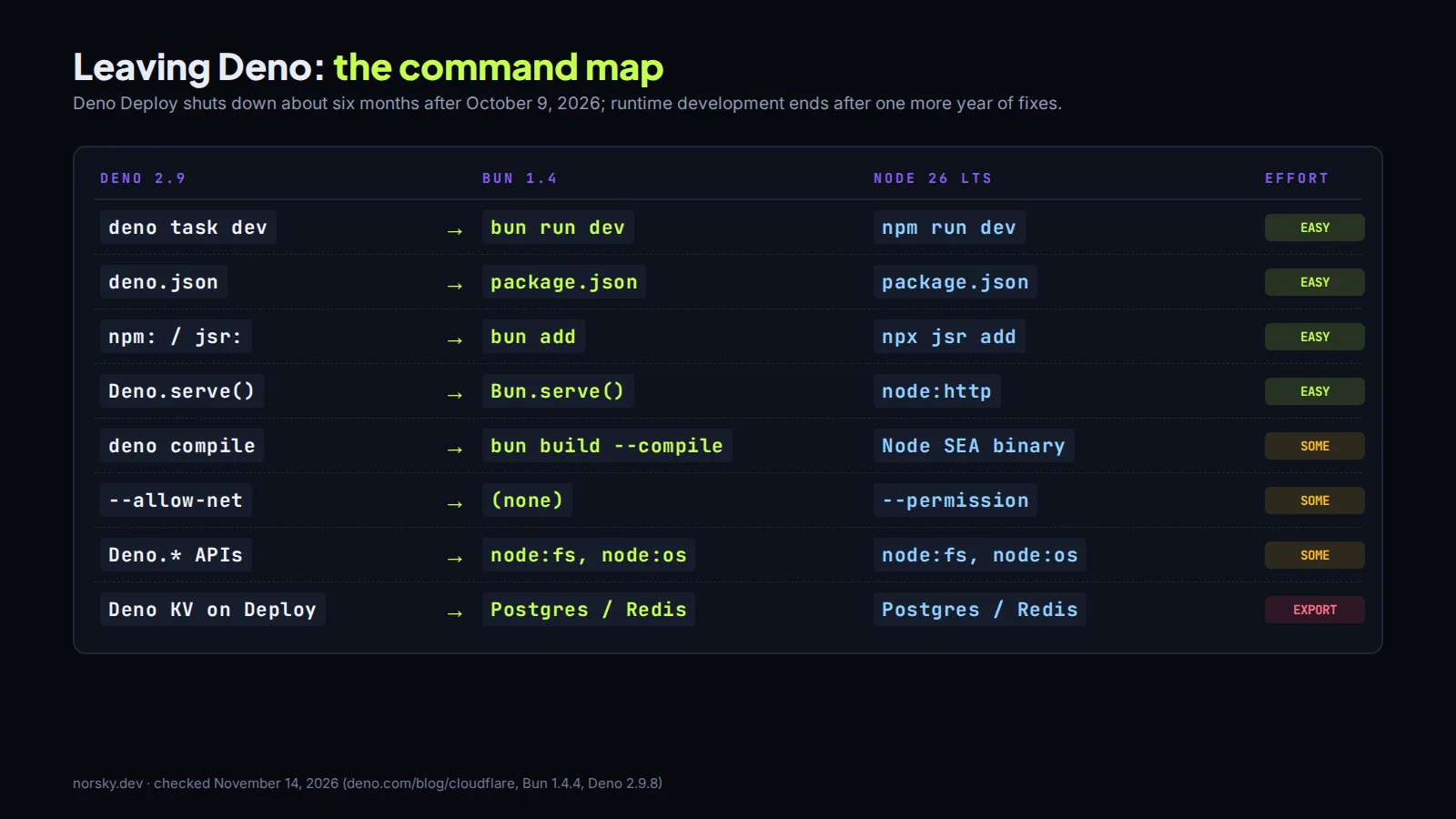
Most of a typical Deno 2 HTTP service moves to Bun in an afternoon. Deno.serve becomes Bun.serve (or plain node:http if you want to keep your options open), deno task entries become scripts in package.json, and npm: and jsr: imports become normal dependencies (JSR packages install through npm with npx jsr add). The slow parts are the Deno.* APIs scattered through the code, KV, and anything that relied on the permission flags to be safe.
If it's a small service, I'd skip Bun and go straight to Node 26 LTS with tsx or Node's own type stripping. You only want to migrate once.
If you've got a Deno app that needs moving off Deploy before April, or a Bun-or-Node decision you'd rather not make alone, I do this kind of work, and the first call is free: book a time.
Introductory offer
Free cloud cost optimization. You only pay from what I save.
I cut your AWS, cloud, Supabase or Vercel bill for free and keep half of what I save for 6 months. Save nothing, pay nothing. Code, architecture and infrastructure.